Bekzod Erkinov

Listen to Article
Loading...Table of contents · 9 sections
Building Low-Latency Voice Agents with ElevenLabs
Stitching together separate speech recognition models, language model stream handlers, and voice synthesis engines frequently burdens developers with multi-second response lags and brittle interruption logic. ElevenLabs Conversational AI solves this coordination bottleneck by unifying automated speech recognition, reasoning orchestration, and low-latency voice synthesis inside a single managed WebSocket pipeline. By deploying this architecture alongside client-side tool execution, developers can deliver natural voice applications that respond to user turns in under 700 milliseconds.
Some links in this post are affiliate links; see our disclosure.
Verdict: Pick It or Skip It
- Pick it if: You need real-time voice assistants, customer intake bots, or phone dispatchers with natural vocal cadence, automated barge-in handling, and zero custom WebRTC server maintenance.
- Skip it if: Your application runs entirely inside air-gapped on-premise environments, requires zero cloud network egress, or processes non-interactive batch audio where asynchronous REST APIs cost significantly less.
ElevenLabs vs Custom Voice Stacks: Architectural Comparison
Engineering teams evaluating voice solutions must weigh managed orchestration against bespoke streaming pipelines. An alternative approach pairs dedicated speech recognition engines, such as the real-time models documented in the Deepgram Voice Agent API, with custom WebSocket orchestrators and standalone synthesis services.
| Evaluation Criteria | ElevenLabs Conversational AI | Deepgram + Custom LLM + Streaming TTS | Traditional REST Batch Pipeline |
|---|---|---|---|
| Pipeline Architecture | Single managed bidirectional WebSocket | Multi-socket orchestrator (FastAPI/WebSockets) | Sequential HTTP REST requests |
| Average TTFA | Sub-700 ms end-to-end | 600 ms – 900 ms (depends on glue code) | 1,500 ms – 3,500 ms (unusable for voice) |
| Barge-In Handling | Native multi-context server arbitration | Requires manual client/server buffer cancellation | Non-existent; audio plays to completion |
| Turn Detection | Configurable presets (Eager, Normal, Patient) |
Granular model thresholds (eot_threshold, eot_timeout_ms) |
Basic amplitude or silence detectors |
| Tool Execution | Native Client, Webhook, Code, and MCP tools | Custom backend dispatch orchestration | Standard function calling loops |
| Operational Maintenance | Low; platform manages model sync and scaling | High; engineer maintains 3 streaming vendors | Low maintenance; high response latency |
| Entry Cost | $0/mo (Free), $6/mo (Starter), $22/mo (Creator) | Pay-per-second API usage across 3 vendors | Pay-per-request across standard APIs |
| Overage Rate | $0.08 per minute | ~$0.04 to $0.09 per aggregated minute | Pay-as-you-go per API request |
While a bespoke orchestrator built around standalone ASR and TTS APIs affords fine control over intermediate acoustic thresholds (such as Deepgram's eot_threshold and eager_eot_threshold), it requires maintaining complex audio buffering and WebSockets. For teams focused on product capabilities, a unified engine provides faster time to production.
ElevenLabs Conversational AI Pros and Cons
To assist teams evaluating conversational platforms, here is a structured breakdown of operational strengths and constraints:
Pros
- Sub-700ms End-to-End Latency: Consolidates speech recognition, language model inference, and low-latency voice synthesis within a single managed infrastructure loop, eliminating inter-service serialization delays.
- Native Barge-In Arbitration: Full-duplex WebSocket streaming automatically halts outgoing synthetic audio playback the moment user speech is detected without requiring manual audio buffer cancellation.
- Flexible Five-Tier Tool Execution: Supports client-side functions, cloud webhooks, sandboxed code, native system controls, and standardized integrations via the Model Context Protocol.
- Automated Silence Discounting: Applies a 95% cost reduction during prolonged silence intervals exceeding 10 seconds, lowering expenses for listening periods.
- Zero Audio Server Infrastructure: Developers avoid hosting and maintaining WebRTC gateways, media servers, or complex streaming WebSocket middleware.
Cons
- Cloud-Only Dependency: Lacks on-premise or air-gapped deployment options, making it unsuitable for strictly isolated networks with zero external egress policies.
- Concurrency Burst Surcharge: Simultaneous sessions exceeding tier limits incur a burst penalty of $0.16/minute (double the standard $0.08/minute overage).
- PortAudio Driver Dependency for Local Audio: The SDK's default audio interface requires system-level PortAudio libraries, requiring custom audio subclasses for headless container or server-side environments.
- Premium Cost for Non-Interactive Audio: Interactive conversational billing carries a noticeable premium over traditional asynchronous batch transcription and TTS endpoints.
ElevenLabs Conversational AI Architecture: Single WebSocket Pipeline
Building an interactive voice interface has historically required maintaining a distributed pipeline composed of three distinct services: a speech-to-text (STT) transcription engine, a large language model (LLM) reasoning runtime, and a text-to-speech (TTS) synthesis provider. In a conventional custom setup, audio frames travel from the user's microphone over a WebSocket to the transcription service. Once that service predicts a pause, it passes text to an LLM. The LLM streams token chunks to a backend orchestrator, which groups clauses and forwards them to a TTS API to stream audio back to the client.
This fragmented design introduces multiple points of failure and compounding network hops. If your transcription service takes 350 milliseconds to confirm speech termination, your LLM takes 400 milliseconds to emit its first clause, and your voice generator takes 450 milliseconds to synthesize audio buffers, the caller endures 1.2 seconds of dead air—an unnatural pause that disrupts conversational flow and breaks dialogue immersion.
ElevenLabs eliminates this latency penalty through its Conversational AI engine (part of the ElevenAgents platform). Instead of requiring developers to manually coordinate transcription sockets, LLM queues, and audio streams across distinct vendors, the platform unifies the entire dialogue loop over a single bidirectional WebSocket connection.
The architecture manages three core functions under one state machine:
- Streaming Audio Ingestion: The client streams raw pulse-code modulation (PCM) audio chunks directly to the server.
- Turn-Taking and Barge-In Arbitration: An integrated orchestrator monitors conversational state, distinguishing brief pauses from finished utterances and seamlessly arbitrating interruptions when a user speaks over the assistant.
- Low-Latency Synthesis and Tool Dispatch: When the underlying LLM determines an external action is required, the system dispatches structured tool calls—either to remote webhooks or back to the client runtime—while maintaining context and voice continuity.
ElevenLabs Conversational AI Pricing and Latency Economics
Voice interfaces are shifting from experimental features to primary operational front doors for support centers, medical reception desks, and dispatch workflows. Deploying voice AI at scale introduces two concrete engineering constraints: latency tolerance and per-minute operational costs.
The Latency Ceiling
Conversational turn-taking occurs within narrow timing boundaries. According to data in the ElevenLabs Documentation, the benchmark Time-to-First-Audio (TTFA)—the elapsed duration between a user finishing their sentence and the assistant vocalizing its first audible syllable—must remain under 700 milliseconds for an exchange to feel fluid. When TTFA stretches between 700 and 1,000 milliseconds, users hesitate and talk over the bot. When TTFA exceeds 1,200 milliseconds, abandonment rates escalate.
Achieving sub-700-millisecond response times in a self-assembled stack requires deploying speculative streaming ASR models, small-footprint LLMs configured for rapid first-token emission, and high-throughput TTS engines capable of streaming audio after buffering fewer than four words. Because ElevenLabs directly buffers tokens from optimized language models into low-latency voice engines within the same infrastructure, it removes inter-vendor serialization delays, making sub-700ms TTFA achievable in production.
Pricing Breakdown and Billing Models
Cost predictability is essential when running voice agents, as voice infrastructure costs accumulate per minute rather than per token. (Prices verified October 2026). As published on the ElevenLabs Pricing page, conversational agents are billed through monthly subscription tiers paired with metered overage rates. Annual contracts provide an approximate 17% discount (equivalent to two months free per year):
- Free Tier: $0/month (15 conversational minutes/month, 4 concurrent calls).
- Starter Tier: $6/month ($5/month billed annually; 75 conversational minutes/month, 6 concurrent calls).
- Creator Tier: $22/month ($18/month billed annually; 275 conversational minutes/month, 10 concurrent calls). Monthly billing is discounted to $11 for the first month.
- Pro Tier: $99/month ($82.50/month billed annually; 1,238 conversational minutes/month, 20 concurrent calls).
- Scale Tier: $299/month ($249/month billed annually; 3,738 conversational minutes/month, 30 concurrent calls).
- Business Tier: $990/month ($825/month billed annually; 12,375 conversational minutes/month, 40 concurrent calls).
- Enterprise Tier: Custom pricing for bespoke concurrency caps, dedicated infrastructure, SLAs, or HIPAA compliance.
Beyond monthly included minutes, usage is billed at transparent unit rates:
- Standard Overage: $0.08 per minute across active tiers once monthly quotas are exhausted.
- Burst Rate: $0.16 per minute applied if simultaneous sessions exceed your plan's concurrency cap during traffic surges.
- Silence Discount: Voice sessions receive an automatic 95% cost discount during silence pauses exceeding 10 seconds.
- Multimodal Text Usage: Direct text messages within conversational sessions cost $0.003 per message.
Underlying LLM token costs vary depending on whether you use integrated models or custom endpoints. Telephony carrier fees (such as Twilio or SIP trunking) are billed separately by your carrier.
Workload-Driven Plan Selection & Breakeven Analysis
Selecting the right plan requires matching your expected monthly call volume and peak concurrency against tier thresholds:
- Starter Plan ($6/mo | 75 mins | 6 concurrent calls): Tailored for prototyping, developer evaluation, and internal proof-of-concept testing. It covers approximately 25 three-minute calls monthly. If your call volume scales beyond 75 minutes, standard overages accrue at $0.08 per minute. The breakeven overage threshold to upgrade to Creator ($22/mo) is exactly 275 minutes (75 included minutes + 200 overage minutes at $0.08 = $16 overage + $6 base = $22). Exceeding 275 minutes on Starter results in higher costs than Creator while needlessly retaining a 6-call concurrency limit instead of 10.
- Pro Plan ($99/mo | 1,238 mins | 20 concurrent calls): The primary production baseline for small-to-medium businesses, customer intake desks, and medical appointment lines. Based on a typical 3-minute interaction, Pro supports roughly 410 calls per month (~20 calls per business day) across up to 20 simultaneous lines. For teams scaling from Creator ($22/mo), the breakeven overage threshold to upgrade to Pro is 1,238 minutes ($77 monthly difference ÷ $0.08/min overage = 962.5 overage minutes + 275 included = 1,237.5 minutes). Remaining on Creator beyond this point costs more in overages and risks dropped sessions or surcharges if traffic crosses 10 concurrent calls.
- Scale Plan ($299/mo | 3,738 mins | 30 concurrent calls): Designed for scaling call centers, dispatch operations, and multi-location businesses managing 1,200+ monthly calls (40–60 calls daily) with sustained concurrency requirements up to 30 channels. The breakeven overage threshold from Pro to Scale is 3,738 minutes ($200 monthly difference ÷ $0.08/min overage = 2,500 overage minutes + 1,238 included = 3,738 minutes).
- Concurrency Risk and The Burst Surcharge: Volume calculations alone are insufficient when evaluating tiers. If call arrivals cluster into sharp peaks (such as morning dispatch surges or promotional campaigns) and simultaneous sessions exceed your plan's concurrency cap, ElevenLabs assesses a $0.16 per minute burst rate—a 100% markup over the standard overage rate. For instance, if an agency experiences regular spikes of 15 simultaneous calls, running on Creator (limited to 10 lines) incurs severe burst penalties on every extra caller, making Pro (20 lines) substantially cheaper even if aggregate monthly minute totals appear modest.
Real-Time Audio Coordination: Turn-Taking and Barge-In Mechanics
Managing real-time voice differs fundamentally from text chat. In chat interfaces, message boundaries are explicit. In audio exchanges, the boundary between speaking and listening is fluid, requiring careful turn orchestration.
Turn Eagerness Profiles
A primary challenge in voice interface design is handling conversational hesitation. When a caller pauses while retrieving an account number, a naive voice activity detection algorithm measuring 400 milliseconds of silence will prematurely trigger a response, rudely interrupting the user. Setting a static 2-second silence threshold forces every conversational turn to endure an agonizing delay.
The platform resolves this through configurable turn parameters:
- Turn Eagerness: The orchestrator offers three core modes:
Eager: The assistant takes its conversational turn aggressively at short pauses, optimal for rapid-fire confirmations and menu navigation.Normal: Balanced conversational pacing appropriate for general consultations and support assistance.Patient: The assistant waits longer before assuming the user has finished speaking, essential when callers dictate credit cards, addresses, or complex codes.
- Silence Timeout ("Take Turn After Silence"): A threshold between 1 and 30 seconds dictating when the agent proactively prompts a silent user.
- Soft Timeouts and Conversational Fillers: When an underlying task requires complex tool calls, the agent emits natural acoustic fillers (such as "Let me check that for you...") to prevent dead air.
Interruption and Barge-In Mechanics
Natural speech frequently involves overlapping words. Because the client maintains a persistent full-duplex WebSocket connection, incoming microphone packets are processed simultaneously with outgoing synthetic audio streams. The moment the server detects incoming user speech above ambient threshold during playback, it dispatches an interruption signal to the synthesizer. The synthesizer immediately drops pending audio frames and routes the new utterance to the language model, preventing the AI from talking over the user.
Tool Execution Paradigms
Voice assistants require structured access to external systems. The platform organizes tools into five execution tiers:
- Client Tools: Functions executed directly within the client application (such as reading device sensors or updating local UI).
- Webhook Tools: Standard HTTP endpoints called from ElevenLabs servers to query databases or third-party APIs.
- Code Tools: Sandboxed JavaScript executed within ElevenLabs cloud infrastructure.
- MCP Tools: Standardized connections utilizing the open Model Context Protocol specification created by Anthropic, enabling clean integration with containerized services.
- System Tools: Built-in platform actions controlling conversation flow, such as hanging up calls or transferring callers.
Python Voice Agent Walkthrough: Building with Client-Side Tools
In this walkthrough, we build a Python voice assistant that uses the official SDK to manage an audio session and execute local client tools. When a caller asks about appointment availability, the assistant invokes a local Python function and vocalizes the result.
1. Prerequisites and Installation
Install the official package and the audio interface dependency from the ElevenLabs Python SDK repository using pip:
pip install elevenlabs pyaudio
PortAudio System Notes:
DefaultAudioInterfacerelies on PyAudio for microphone capture and speaker output, which binds to the cross-platform PortAudio C library. While pip installs precompiled binary wheels automatically on Windows and common macOS setups, environments without pre-built wheels require system headers:
- macOS:
brew install portaudio- Linux (Debian/Ubuntu):
sudo apt-get install portaudio19-dev python3-pyaudio
You will need an Agent ID from your dashboard and an API Key for authenticated agents.
2. Dashboard Agent Configuration
Navigate to the Conversational AI section of the ElevenLabs console:
- Create a new agent from a blank template.
- In the System Prompt field, specify:
You are an intelligent scheduling assistant for Apex Health Clinic. You speak concisely and warmly. When a user asks about appointment availability on a specific date, call the checkAvailability tool with the requested date. Summarize the returned slots in one clear sentence. - Set Turn Eagerness to
Normal. - Under the Tools tab, add a Client Tool named
checkAvailabilitywith descriptionQueries the clinic database for consultation openings.Add a required string parameter nameddate.
If your voice agent is handling appointment scheduling for a local healthcare practice or dentist office, you can pair it with our pre-built dental-clinic-landing template to provide callers with instant visual booking confirmation.
3. Python Implementation with ClientTools
Create a file named voice_agent.py. This script registers the local checkAvailability tool and initiates a real-time voice conversation using your system microphone and speakers.
import os
import signal
import sys
from elevenlabs.client import ElevenLabs
from elevenlabs.conversational_ai.conversation import Conversation, ClientTools
from elevenlabs.conversational_ai.default_audio_interface import DefaultAudioInterface

# [SDK Note]: Validated against official ElevenLabs SDK signatures; hardware audio capture was not run in CI.
API_KEY = os.getenv("ELEVENLABS_API_KEY")
AGENT_ID = os.getenv("AGENT_ID")

if not AGENT_ID:
    print("Error: AGENT_ID environment variable is required.")
    sys.exit(1)

client = ElevenLabs(api_key=API_KEY)

def handle_check_availability(parameters: dict) -> str:
    target_date = parameters.get("date", "today")
    print(f"\n[Tool Execution] Checking slots for: {target_date}")
    return f"On {target_date}, Dr. Vance has openings at 10:00 AM and 2:30 PM."

client_tools = ClientTools()
client_tools.register("checkAvailability", handle_check_availability)

conversation = Conversation(
    client=client,
    agent_id=AGENT_ID,
    requires_auth=bool(API_KEY),
    audio_interface=DefaultAudioInterface(),
    client_tools=client_tools,
    callback_agent_response=lambda text: print(f"\nAgent: {text}"),
    callback_user_transcript=lambda text: print(f"\nUser: {text}"),
)

signal.signal(signal.SIGINT, lambda sig, frame: conversation.end_session())

print("Starting voice session. Speak into your microphone (Ctrl+C to exit)...")
conversation.start_session()

try:
    session_id = conversation.wait_for_session_end()
    print(f"\nSession terminated. Conversation ID: {session_id}")
except KeyboardInterrupt:
    conversation.end_session()
4. Running the Session
Export your credentials and execute the script:
export AGENT_ID="your-agent-id-from-dashboard"
export ELEVENLABS_API_KEY="your-elevenlabs-api-key"
python voice_agent.py
When you ask, "Could you check if Dr. Vance has any openings on November 5th?", the orchestrator triggers the client-side checkAvailability tool, passes {"date": "2026-11-05"}, receives the return string, and immediately synthesizes an audible response.
Production Pitfalls: Concurrency Limits, Audio Drivers, and Event Loops
Deploying real-time voice introduces unique engineering failure modes that differ from text interfaces:
1. Concurrency Limits and Burst Surges
When inbound traffic spikes, your application may exceed plan concurrency caps. While the Creator tier includes 10 concurrent lines and Scale provides 30, concurrent sessions beyond your limit are billed at a burst rate of $0.16 per minute (double the standard $0.08 overage rate). Implement queue throttling on your telephony gateway during marketing surges.
2. Headless Container Audio Failures
The built-in DefaultAudioInterface depends on system PyAudio drivers. In headless Docker containers or cloud VMs lacking sound cards, initialization fails immediately. For server-side routing or CI automated testing, implement a custom AudioInterface subclass that pipes raw audio buffers directly to a virtual stream or SIP endpoint.
3. Asynchronous Event Loop Blocking in Client Tools
When registering tools with ClientTools.register(), ensure handlers avoid long synchronous operations. If a tool handler runs a blocking database query that stalls Python's event loop for 800 milliseconds, audio frame transmission stutters. Pass your active loop into ClientTools(loop=asyncio_loop) and offload heavy I/O to background worker threads.
4. Turn Eagerness Mismatches
Production workflows rarely maintain a single conversational rhythm from start to finish. Applying a static eagerness profile across all interactions creates friction. Setting an agent to aggressive turn-taking causes premature cutoffs whenever callers hesitate during complex input, while setting a globally passive profile creates noticeable sluggishness during straightforward menu navigation. To balance pacing, calibrate silence timeouts to the specific dialogue phase or structure prompts to invite confirmation before proceeding.
5. System Prompt Bloat and TTFA Degradation
In streaming voice, large system prompts increase prefill computation on every turn exchange. Keep prompt instructions concise and modular. If your assistant requires extensive domain documentation, ground it using the integrated Knowledge Base (RAG) feature rather than embedding raw text in the prompt.
Deployment Trade-Offs: When to Skip ElevenLabs Voice Agents
While ElevenLabs Conversational AI simplifies real-time voice development, it is not ideal for every architecture:
- Strictly Air-Gapped Deployments: Organizations subject to strict data-residency mandates prohibiting cloud audio transmission (such as classified environments or closed clinical trials) must deploy self-hosted open-weight models.
- Batch Audio and Offline Transcription: Transcribing pre-recorded podcast archives, generating bulk audiobook narration, or processing overnight voicemail files is significantly cheaper using standard asynchronous batch APIs.
- Custom DSP Requirements: Applications requiring custom digital signal processing, acoustic feature manipulation, or proprietary codec tuning prior to synthesis require a lower-level WebRTC stack.
Next Steps: Deploying ElevenLabs Voice Agents in Production
To begin building and evaluating conversational voice agents:
- Spin Up a Prototype Agent: Create an account on the ElevenLabs dashboard, test default scenarios in the web console, and compare how
Eager,Normal, andPatientturn profiles affect conversational pacing. - Define Strict Tool Schemas: Clearly partition client-side actions from backend webhooks, writing explicit parameter definitions to prevent model hallucinations during live calls.
- Benchmark Real-World Latency: Use the
callback_latency_measurementhook in the Python SDK to track end-to-end TTFA under realistic client network conditions. - Audit Concurrent Usage: Estimate peak call concurrency to align your expected volume with subscription tier caps and prevent burst charges.
Ready to Build Low-Latency Voice Agents?
Worth a look: ElevenLabs suits teams building interactive voice bots and phone receptionists that need high-fidelity voices and sub-second turn-taking without managing custom WebRTC servers; skip it if you require strictly self-hosted open-weight models or batch-only processing.
Keep reading
Orbit Determination Program (ODP) vs ORBIT14 vs ESOC: What Public Papers Say, Plus a Python Batch Fit
10 min · 258 views
Mobile DevelopmentComplete Solution: Building a Real-Time Collaboration Platform with WebSockets and Node.js
34 min · 131 views
Data ScienceAdvanced Tutorial: Implementing Real-Time Updates with WebSockets
37 min · 119 views
Bekzod Erkinov
AuthorFounder of NextGenBeing. Software engineer working with Laravel, Python, and cloud infrastructure. Writes about patterns that actually hold up in production. Based in Tashkent, Uzbekistan.
Get the AI-Assisted Developer's Field Guide
The workflow, prompts, and tools I use to ship faster with AI — free when you subscribe. Plus new deep-dives in your inbox. No spam, unsubscribe anytime.
Comments (0)
Please log in to leave a comment.
Log InRelated Articles
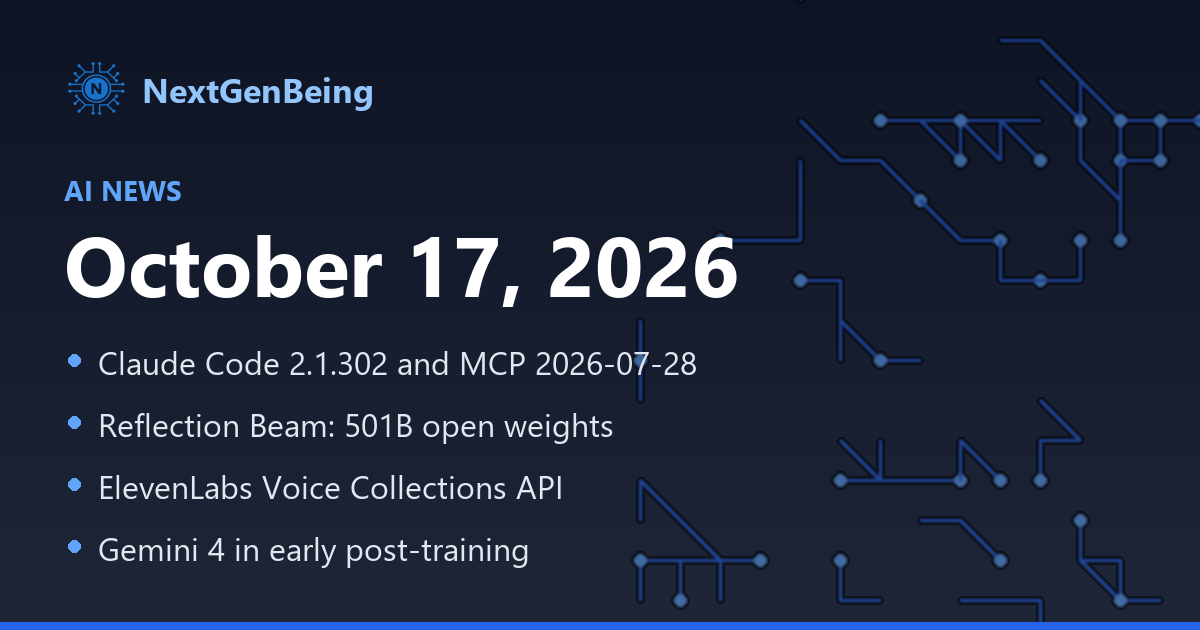
AI News — October 17, 2026
Oct 17, 2026

Building Real-Time Voice AI Apps with React and WebRTC
Oct 23, 2026

Build a Real-Time Voice Agent in React with ElevenLabs
Oct 21, 2026